This is a post that I've had in mind for a while now but didn't have time to write.
I travel with my dog in the car often, and I'm sure I'm not alone in that.
Owen
has always been a good traveler and has never gotten in my way or been a
distraction when I drive. However, I still decided early this year that
I would get him a car safety harness. The reasons for this are: to
protect him if I'm ever in an accident with him, to protect me if I'm
ever in an accident with him since he could become a projectile, and to
keep him restrained in the car (even though he's never been a
distraction before).
Car harnesses are not all created equal,
though many have gotten better over the years since testing of them was
first initiated.
Zip-line restraints and some booster seats are
not crash-tested. Some harnesses that claim to be crash-tested don't say
if they passed those tests or not. The market is not regulated so one
must be careful when selecting a harness.
The
harness that I selected for Owen is one that passes those tests and has
been tested multiple times (the tests are based on child safety seat
tests in the US). I feel safer and know that he is also safer when he
wears his harness. I selected the PetSafe Happy Ride Safety Harness in
size medium. This harness has passed safety tests since it was first
launched and is now a safe harness for dogs.
While I have not had
to use customer service at this time, the company will replace a
harness from ANY company if you are in an accident with your pet with
that harness, because they believe that harnesses should be replaced
after an accident due to the forces on them.
One thing that
you must also do is ALWAYS use the harness. If you get into the habit of
not using it because you're "just going down the street" or something
like that, using it won't become a habit and it won't help you because
you'll use excuses to not have it on your dog.
So, to keep your dog safe, consider getting a car harness!
PetSafe Happy Ride Safety Harness ratings:
Wednesday, April 8, 2020
Monday, January 13, 2020
New Year, New Goals!
Happy New Year everyone.
I hope that 2020 is going well so far. This year, I think
all of us as pet owners should strive to do better for our pets. Here are some
suggestions for ways to be a better pet owner.
1. Feed a better food. Food quality makes a huge difference
in the health of your pet(s). Because of this, we should all try to feed a
better food this year. That can mean different things for everyone. Feed a
better kibble if that’s all your pet eats. Introduce wet food into your pet’s
diet. Introduce fresh, homemade (make sure it’s balanced) or raw food. Just
make sure to keep portions correct.
2. Help your pet lose weight. To go along with the
previously mentioned suggestion of better food, make sure you are not feeding
too much. Extra pounds make your pet more likely to have health problems so
help them to get that extra weight off. Exercise, feed less, use lower calorie
treats, etc.
3. Exercise and play more. If you have a dog, make sure to
walk them as often as you can. Play with your pet(s) to make sure they get
mental stimulation as well as exercise. You are your pet’s caretaker and are
responsible for making sure they get to experience fun.
4. Take your dog to the vet on a regular basis. This one is
important. Dogs in all places are at risk of vaccine-preventable diseases,
parasites, and other illnesses. The best way to protect your pet and get things
diagnosed and treated is to regularly visit a vet.
5. BE A BETTER DOG OWNER. This one is specifically for dog
owners. Frequently dog owners get a “bad rap” because of a small number of
owners who ARE irresponsible. Because of these “bad” owners, dogs are
frequently banned from public places and are prohibited from activities. Be
better and do better. If you’re out in public with your dog, CLEAN UP after him
or her. No, it’s not the most pleasant thing but it is YOUR dog and therefore
YOUR responsibility. Teach your dog to have good manners and to be friendly. If
your dog is not good with people or other dogs, etc. don’t bring them out in public.
Follow the law and don’t let your dog off leash in areas with leash laws. Don’t
let them run up to people without making sure it’s OK with the person first. I’m
tired of seeing people who don’t do these things because honestly, it ruins things
for all other dog owners (the responsible ones). If we want people to accept
dogs and dog owners in public places then we need to make sure to be
responsible.
Labels:
cat food,
cat weight loss,
Cats,
dog food,
dog weight loss,
Dogs,
exercise,
good owner,
New Year,
play with cat,
play with dog,
veterinarian,
walk dog
Thursday, December 12, 2019
"Quality control" plans are only good if followed through with
This is an article that I’ve wanted to write for a while,
but now I have published facts to back up my post.
As many may know, the dilated cardiomyopathy (DCM) issue in
dogs (which may or may not be nutritional in nature since the cause has yet to
be determined) has led certain people and groups to basically say that anyone
who feeds their dog(s) anything but the “big five” foods, which for them are Hill's,
Purina, Royal Canin, Iams, and Eukanuba, is doing harm to their dogs. These
people and groups tout the research done by these companies and the “quality
control”/in-house manufacturing as what sets them apart from other pet foods
(which by the way is not something that actually sets them apart as many other
pet food companies do research and manufacture their own food). I’ve heard
these arguments many times and I don’t buy them at all. Here is an example of why.
Hill's Pet Nutrition had a major recall early this year (2019) that started in late January
with 25 different varieties of canned dog food due to excessive vitamin D
levels. At the time Hill's said that they had identified all the lots affected
by the issue and had removed them all from shelves. Then on March 20th
(48 days after the initial recall!), Hill's expanded the recall to include 20
additional lots of food of 8 new varieties. Another lot of food was added to
the recall on May 20th.
After the recall was initiated, the FDA went to the
manufacturing facility and collected samples and evaluated the protective
measures (quality control measures) that Hill's had in place to try to find out
what went wrong. What they (FDA) found was quite interesting. Hill's, indeed,
had safety plans to prevent this type of issue from occurring. However, they
did not follow through with those plans. Specifically, they did NOT test
ingredients prior to implementing them into foods as their plans required. They
also were supposed to obtain a certificate of analysis from ingredient
suppliers that showed the ingredients being delivered were within the specifications.
Guess what? They didn’t do that either!
So while a company can say that they have amazing quality
control and will tout this on tours—as I’ve heard people who have toured the
facility aver that Hill's does—and say that they are better because they make
their own food, that is not necessarily true. Hill's has been saying for a long
time that they do testing of ingredients and that they have excellent quality
control, and yet they had dog foods get onto retail shelves that had 33x the upper
safe levels of vitamin D and are responsible for the deaths of numerous dogs.
So when I see these DCM groups promoting these brands (and
spamming other pages and posts on social media and on retail sites) based on supposed “research”
and “quality control”, I have to laugh because they are completely suckered in
in the very same way they accuse others of being with other brands and don’t
see it. No one knows the answer to the DCM issue yet and, even if it is a nutritional issue with some formulations, it does not affect all (or even a majority of all) foods that are not the "big five" so the recommendations being pushed are incorrectly narrow and not based on facts.
Specifics on dates, products, and violations
retrieved from FDA Warning Letter to Hill's Pet Nutrition:
https://www.fda.gov/inspections-compliance-enforcement-and-criminal-investigations/warning-letters/hills-pet-nutrition-inc-576564-11202019
Saturday, June 29, 2019
Dilated Cardiomyopathy update after FDA update on 6/27/19
For anyone who has not read the June 27th update from the FDA on the dilated cardiomyopathy (DCM) issue potentially related to dog food, here it is (along with the Vet-LIRN update from FDA):
https://www.fda.gov/animal-veterinary/news-events/fda-investigation-potential-link-between-certain-diets-and-canine-dilated-cardiomyopathy
https://www.fda.gov/animal-veterinary/science-research/vet-lirn-update-investigation-dilated-cardiomyopathy
Now, I am currently feeding Owen a food which doesn't have any legumes. I also use some wet foods as toppers and I avoid peas/lentils/legumes in them as well.
I read the entire report from FDA and even read all the reports that were submitted to FDA. I am honestly not completely sure what to make of the whole situation. There are reports of somewhere around 560 dogs (probably higher now but we don't know how much higher) that have DCM apparently linked to diet. However, as FDA says, there are over 77 million pet dogs in the U.S. so that is not a high percentage with DCM. There is the possibility, however, that there are many more affected that are not diagnosed because of the expense of diagnostic tests and/or owner lack-of-knowledge about the condition.
I am still of the opinion that this is a nutrient deficiency or a toxicity related to something in the food. I am not of the opinion that dogs NEED grains, because that simply doesn't make any sense from a biology perspective. I do think that we, as pet owners, should probably avoid foods that have peas/a lot of peas until we know more about the cause (which FDA still hasn't found). Based on the information that FDA provided, I do not believe potatoes are an issue at all.
I still find it very odd and interesting/telling that cats are not really affected by this (there have been a VERY few cases but not significant at all). I believe that this fact suggests that it is a nutrient deficiency related to an amino acid that is either not in sufficient quantities in the food or not being absorbed for some reason. The reason I think it may be an amino acid deficiency is that cat foods are nearly all supplemented with more amino acids than dog food is because cats have a very high requirement.
If you read the necropsy reports from FDA, they found fat accumulation around the heart of many of the affected dogs. This makes ME wonder/speculate if it might be related to carnitine, an amino acid. Carnitine is required for fatty acid metabolism and there are scientific articles that state that without carnitine in sufficient quantity fat will build up in the body in various places. Cat foods are more likely to be supplemented with carnitine (and other amino acids) than dog food. In addition, the amino acid lysine is the precursor to carnitine (it must be present in the diet in sufficient quantity for the body to make carnitine). Lysine is easily broken down in the production of dry food. A reaction known as the Maillard reaction occurs, which causes the irreversible binding of lysine with sugars/starches in kibble and, therefore, renders the lysine unavailable to the pet.
In any case, I am currently avoiding peas/lentils/legumes in Owen's food (I'm still feeding my cats Blue Wilderness and have no plans to change) and am considering changing his food to one that completely removes peas (I'm currently considering Dr. Tims and Farmina with me leaning towards the Dr. Tims).
If you have any concerns about your pet(s), PLEASE see a veterinarian.
https://www.fda.gov/animal-veterinary/news-events/fda-investigation-potential-link-between-certain-diets-and-canine-dilated-cardiomyopathy
https://www.fda.gov/animal-veterinary/science-research/vet-lirn-update-investigation-dilated-cardiomyopathy
Now, I am currently feeding Owen a food which doesn't have any legumes. I also use some wet foods as toppers and I avoid peas/lentils/legumes in them as well.
I read the entire report from FDA and even read all the reports that were submitted to FDA. I am honestly not completely sure what to make of the whole situation. There are reports of somewhere around 560 dogs (probably higher now but we don't know how much higher) that have DCM apparently linked to diet. However, as FDA says, there are over 77 million pet dogs in the U.S. so that is not a high percentage with DCM. There is the possibility, however, that there are many more affected that are not diagnosed because of the expense of diagnostic tests and/or owner lack-of-knowledge about the condition.
I am still of the opinion that this is a nutrient deficiency or a toxicity related to something in the food. I am not of the opinion that dogs NEED grains, because that simply doesn't make any sense from a biology perspective. I do think that we, as pet owners, should probably avoid foods that have peas/a lot of peas until we know more about the cause (which FDA still hasn't found). Based on the information that FDA provided, I do not believe potatoes are an issue at all.
I still find it very odd and interesting/telling that cats are not really affected by this (there have been a VERY few cases but not significant at all). I believe that this fact suggests that it is a nutrient deficiency related to an amino acid that is either not in sufficient quantities in the food or not being absorbed for some reason. The reason I think it may be an amino acid deficiency is that cat foods are nearly all supplemented with more amino acids than dog food is because cats have a very high requirement.
If you read the necropsy reports from FDA, they found fat accumulation around the heart of many of the affected dogs. This makes ME wonder/speculate if it might be related to carnitine, an amino acid. Carnitine is required for fatty acid metabolism and there are scientific articles that state that without carnitine in sufficient quantity fat will build up in the body in various places. Cat foods are more likely to be supplemented with carnitine (and other amino acids) than dog food. In addition, the amino acid lysine is the precursor to carnitine (it must be present in the diet in sufficient quantity for the body to make carnitine). Lysine is easily broken down in the production of dry food. A reaction known as the Maillard reaction occurs, which causes the irreversible binding of lysine with sugars/starches in kibble and, therefore, renders the lysine unavailable to the pet.
In any case, I am currently avoiding peas/lentils/legumes in Owen's food (I'm still feeding my cats Blue Wilderness and have no plans to change) and am considering changing his food to one that completely removes peas (I'm currently considering Dr. Tims and Farmina with me leaning towards the Dr. Tims).
If you have any concerns about your pet(s), PLEASE see a veterinarian.
Tuesday, March 12, 2019
A strange "bump" on Owen
DISCLAIMERS: I am NOT a veterinarian (I am a veterinary student, but have not finished school yet) so do not take my advice as that of a veterinarian! As always, consult your veterinarian for any concerns you may have about your pet(s).
Also, there are photos below of a skin lesion that might be gross to some people so read below if that's OK with you.
Around the first of the year I bathed Owen (he gets regular baths) and, when I did, I noticed a bump on his left shoulder that had not been there before. It didn't seem to be bothering him, but was about the size of a small pea. I was somewhat concerned at that time but thought that maybe he had scratched himself or something so waited on it to heal.
I continued to watch the spot and, when it didn't go away by the 16th of January, I decided to take some pictures of it to document what it looked like and how large it was so I could monitor it more easily since at that point, I didn't think it was a wound. By this date, it was slightly larger (the size of a small button). Here is what it looked like on that day (16 of January).
At that point, I decided to start trying to figure out what this bump was (being a veterinary student, I had access to good information to do so). I fairly easily discovered that it was likely either a mast cell tumor (VERY concerning as they are malignant) or a histiocytoma (MUCH less concerning). To learn more about histiocytomas, go here. Given Owen's age (3, almost 4 years old), and the location (front limb), I was leaning towards it being a histiocytoma (a benign skin tumor) but wanted to document size and characteristics just to be sure. I decided to wait to take him to the vet (knowing that he was going to be going in March for his annual heartworm test anyway so if it didn't go away, I could get it seen about at that time), monitor, and see if it went away since histiocytomas usually go away within 3 months.
Here's what it looked like on the 28th of January.
At this point, I was fairly convinced that it was indeed a histiocytoma as it wasn't growing rapidly like mast cell tumors often do, nor was it extremely itchy for Owen (it was maybe slightly itchy but not like I've seen dogs with mast cell tumors deal with). I continued to watch it and around February 12th, noticed that it was scabbed over and felt smaller. Here's what it looked like on that date.
Between this time and now, it scabbed over a couple of times, each time getting smaller and smaller as the scabs peeled off. Now, the hair is starting to grow back in and the area is flat again. Here's what it looks like today, March 12th.
So, given the progress and timeline of this "bump", I believe that it was a histiocytoma. Can I prove it? No, because I didn't subject Owen to a biopsy of the lesion. However, this is the most likely condition to behave like this and the signalment fits (Owen is young, the lesion was on his forelimb, it came up rapidly, it regressed within 3 months). The cause of histiocytomas is not known. However, it is thought to be induced by an immune reaction of some kind. Owen already has allergies so maybe that made him more prone to developing it. Who knows. The good thing is that it is gone and, hopefully, won't come back!
Also, there are photos below of a skin lesion that might be gross to some people so read below if that's OK with you.
Around the first of the year I bathed Owen (he gets regular baths) and, when I did, I noticed a bump on his left shoulder that had not been there before. It didn't seem to be bothering him, but was about the size of a small pea. I was somewhat concerned at that time but thought that maybe he had scratched himself or something so waited on it to heal.
I continued to watch the spot and, when it didn't go away by the 16th of January, I decided to take some pictures of it to document what it looked like and how large it was so I could monitor it more easily since at that point, I didn't think it was a wound. By this date, it was slightly larger (the size of a small button). Here is what it looked like on that day (16 of January).
![]() |
| January 16 2019 "Bump" on Owen |
![]() |
| January 16 2019 "bump" on Owen |
Here's what it looked like on the 28th of January.
![]() |
| January 28th "bump" on Owen |
![]() |
| January 28th "bump" on Owen |
![]() |
| February 12 "bump" on Owen |
![]() |
| March 12 "bump" is gone! |
Wednesday, January 23, 2019
Rainy day activities for dogs!
Hello everyone!
The beginning of this year (and late last year) have been very wet in my area (rain, not snow). This has led to days when it has been impossible to go outside for any length of time, which has led to a very unhappy Owen.
These are some of the things I do to keep Owen entertained on these wet days (though these would also totally work for cold/snowy days!).
1. KONG (or similar) toy or food puzzle toy. This one is obvious for many but fill one of these toys with dog food, dog treats, or other yummy food (Owen likes fruits and peanut butter the most in his KONG but also likes dog treats, canned dog food, etc. and in the puzzles, dry things work best). Tip: freeze a KONG before giving to your dog to make it last longer.
2. Give a chew toy. My personal favorite type of dog chew is the Himalayan Dog Chews (https://www.himalayan.pet/products/himalayan-dog-chews). They are fairly long-lasting, safe, and most dogs love them. They will keep a dog busy for quite a long time and will keep them distracted from the fact that they can't go outside to play.
3. Play tug-of-war or fetch with toys. These are also obvious games to play, but can get a lot of energy out, which will lead to a calmer and happier dog on those nasty days.
4. Do a training session. Nothing like a rainy/cold/snowy day to learn a new trick or skill! This can be a great time to teach something fun like "shake"/"give paw", "roll over", "speak", "high five", "spin", etc. but you can also work on basic obedience skills too ("sit", "down", "stay"/"wait", "leave it", "come", etc.).
5. My ALL time favorite game to play with a dog on a rainy day (or ANY day really) is hide and seek! I know! It sounds crazy to play hide and seek with a dog but it is TOTALLY possible and can be a blast for both dog and person!
To teach this game, your dog MUST know how to reliably stay/wait on command while you are out of sight (if you are not there yet with your dog, work on that first by having a training session or two). Start easy by having your dog stay/wait in a sit or a down position. Then go "hide." Make it easy at first, just going out of the room or behind something in the room the dog is in. Call your dog (only once!) or use their "release" (Owen's is "Okay!") word (again, only once). Make sure you have treats and when your dog "finds" you (again, hide in an easy spot at first), praise and give treats to encourage the behavior. Once your dog is good at this, you can make it harder by going farther away and hiding behind/on top of/under things. Remember to always praise your dog verbally and with treats and have fun with this game! It is really fun to have your dog seek you out and it helps build a stronger bond with your dog!
The beginning of this year (and late last year) have been very wet in my area (rain, not snow). This has led to days when it has been impossible to go outside for any length of time, which has led to a very unhappy Owen.
These are some of the things I do to keep Owen entertained on these wet days (though these would also totally work for cold/snowy days!).
1. KONG (or similar) toy or food puzzle toy. This one is obvious for many but fill one of these toys with dog food, dog treats, or other yummy food (Owen likes fruits and peanut butter the most in his KONG but also likes dog treats, canned dog food, etc. and in the puzzles, dry things work best). Tip: freeze a KONG before giving to your dog to make it last longer.
2. Give a chew toy. My personal favorite type of dog chew is the Himalayan Dog Chews (https://www.himalayan.pet/products/himalayan-dog-chews). They are fairly long-lasting, safe, and most dogs love them. They will keep a dog busy for quite a long time and will keep them distracted from the fact that they can't go outside to play.
3. Play tug-of-war or fetch with toys. These are also obvious games to play, but can get a lot of energy out, which will lead to a calmer and happier dog on those nasty days.
4. Do a training session. Nothing like a rainy/cold/snowy day to learn a new trick or skill! This can be a great time to teach something fun like "shake"/"give paw", "roll over", "speak", "high five", "spin", etc. but you can also work on basic obedience skills too ("sit", "down", "stay"/"wait", "leave it", "come", etc.).
5. My ALL time favorite game to play with a dog on a rainy day (or ANY day really) is hide and seek! I know! It sounds crazy to play hide and seek with a dog but it is TOTALLY possible and can be a blast for both dog and person!
To teach this game, your dog MUST know how to reliably stay/wait on command while you are out of sight (if you are not there yet with your dog, work on that first by having a training session or two). Start easy by having your dog stay/wait in a sit or a down position. Then go "hide." Make it easy at first, just going out of the room or behind something in the room the dog is in. Call your dog (only once!) or use their "release" (Owen's is "Okay!") word (again, only once). Make sure you have treats and when your dog "finds" you (again, hide in an easy spot at first), praise and give treats to encourage the behavior. Once your dog is good at this, you can make it harder by going farther away and hiding behind/on top of/under things. Remember to always praise your dog verbally and with treats and have fun with this game! It is really fun to have your dog seek you out and it helps build a stronger bond with your dog!
Tuesday, January 1, 2019
New Year, New Goals!
Hello everyone and Happy New Year!
At this time, it seems everyone sets goals for the new year.
I think one that everyone with pets should set is to feed out pets better. If you're feeding a food that is not considered to be very good, or if you're already feeding a good food, we can ALL do better. Whether that means adding fresh, raw, canned, or switching to a better dry food, we should strive to do better for our pets.
In addition, we should all strive to get our pets into better shape (I also have a cat that needs this: Sunny).
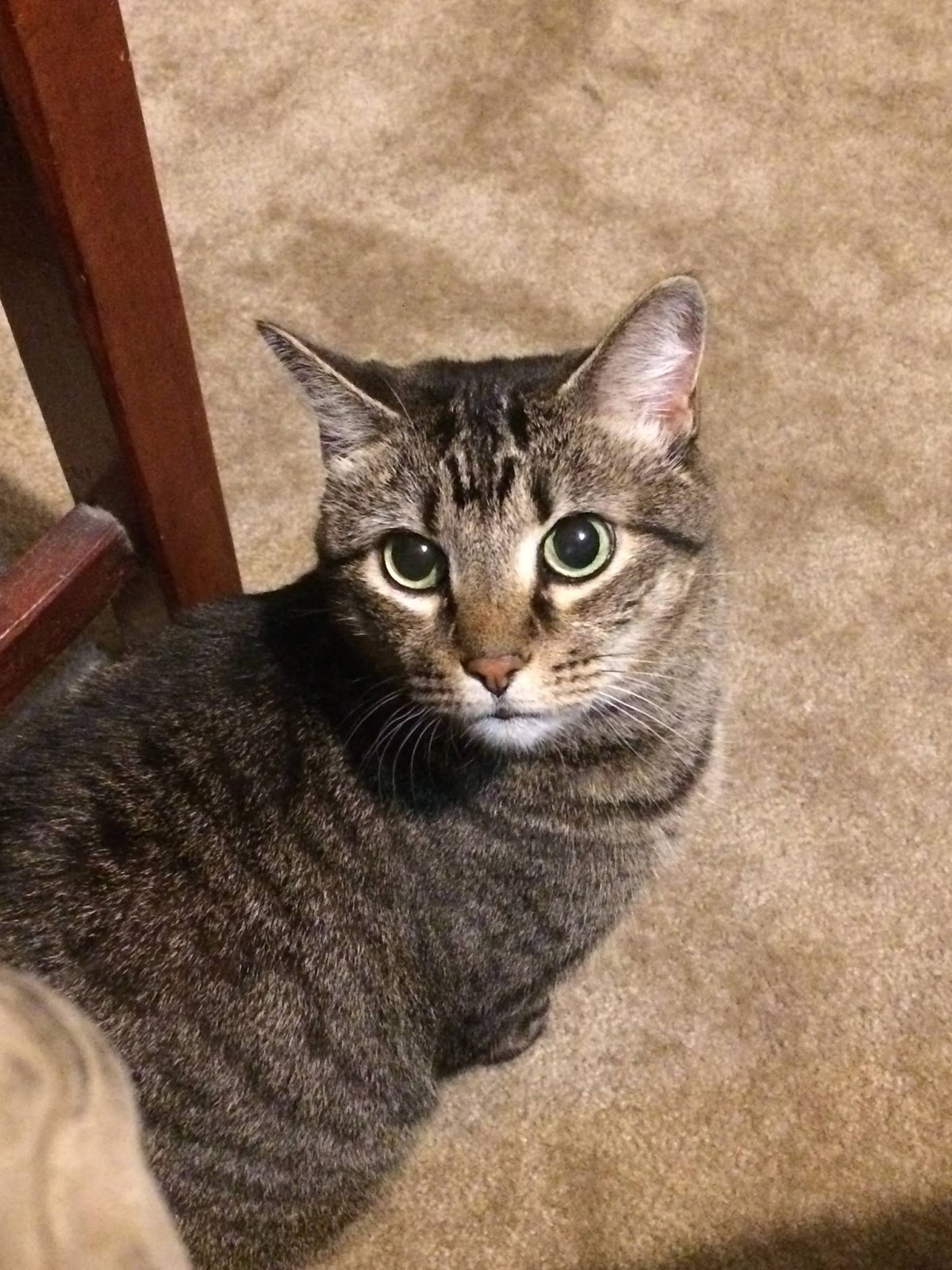
Here are some pictures of Owen, Smokey, and Sunny.
At this time, it seems everyone sets goals for the new year.
I think one that everyone with pets should set is to feed out pets better. If you're feeding a food that is not considered to be very good, or if you're already feeding a good food, we can ALL do better. Whether that means adding fresh, raw, canned, or switching to a better dry food, we should strive to do better for our pets.
In addition, we should all strive to get our pets into better shape (I also have a cat that needs this: Sunny).
Here are some pictures of Owen, Smokey, and Sunny.
Subscribe to:
Posts (Atom)